
The osteodontokeratic industry of the Afonso Garivaldino Rodrigues site, brochier, Rio Grande do Sul
DOI:
https://doi.org/10.24885/sab.v39i3.1363Keywords:
Osteodontokeratic industry, Bone artifacts, ZooarchaeologyAbstract
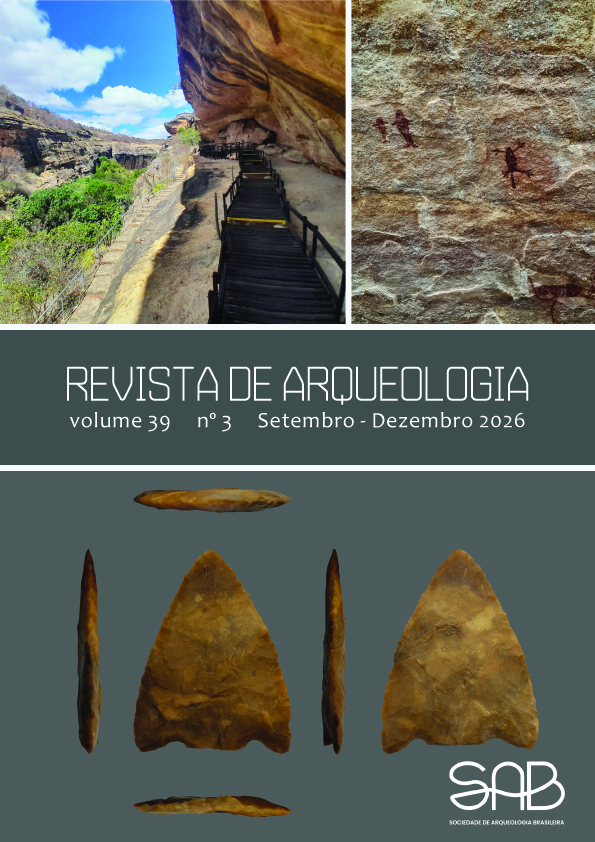
The Afonso Garivaldino Rodrigues site (RS-TQ-58), located in the municipality of Brochier, Rio Grande do Sul, is an archaeological site occupied throughout the early and middle Holocene by hunter-gatherers and, in the late Holocene, by pottery-making groups. The good preservation of the site’s stratigraphic layers makes it possible to observe potential changes or continuities in the frequency and type of artifacts over time. This article presents the osteodontokeratic industry associated with hunter-gatherer groups from this site, including artifacts made of both bone and antler. We therefore propose a typology for these artifacts and the chaîne opératoire involved in their manufacture. The data point to cultural stability throughout the early Holocene.
Downloads
References
AMEGHINO, Florentino. Caracteres diagnósticos de cincuenta especies nuevas de mamíferos fósiles argentinos. Revista Argentina de História Natural, v. 1, p. 129-167, 1891.
ASCHER, Robert. Experimental Archaeology. American Anthropologist, v. 63, n. 4, p. 793-816, 1961.
BLACK-Décima, Patricia et al. Brown Brocket Deer, Mazama gouazoubira (Fisher 1814). In: DUARTE, José M. B.; GONZÁLEZ. Susana (org). Neotropical cervidology: Biology and Medicine of Latin American Deer. Jaboticabal: Funep/IUCN, 2010. p. 190-201.
COLES, John M. Experimental archaeology. Proceedings of the Society of Antiquaries of Scotland, v. 99, p. 1-20, 1967.
DART, Raymond A. The Osteodontokeratic culture of Australopithecus prometheus. Pretoria: Transvaal Museump, 1957.
DUARTE, José M. B. et al. Plano de Ação Nacional para a conservação dos cervídeos ameaçados de extinção. Brasília, DF: Instituto Chico Mendes de Conservação da Biodiversidade, 2012.
DUNNELL, Robert C. Style and Function: A Fundamental Dichotomy. American Antiquity. v. 43, n. 2, p. 192-202, 1978.
ERXLEBEN, Johann C. P. Systema regni animalis per classes, ordines, genera, species, varietates cum synonymia et historia Animalium. Classis I. Mammalia. Lípsia: Imprensis Weigandianis, 1777.
FISCHER, Gotthelf. Zoognosia tabulis synopticis illustrata: in usum praelectionum Academiae imperialis medico-chirugicae mosquensis edita. Moscou: Typis Nicolai Sergeidis Vsevolozky, 1814.
GONZÁLEZ, Susana et al. Pampas deer, Ozotoceros bezoarticus (Linnaeus 1758). In: DUARTE, José M. B.; GONZÁLEZ, Susana (org.) Neotropical cervidology: Biology and Medicine of Latin American Deer. Funep/IUCN, 2010. p. 119-132.
ILLIGER, Johann K. W. Überblick der Säughiere nach ihrer Vertheilung über die Welttheile. Akademie der Wissenchaften 1804-1811, v. 39, 1815.
INIZAN, Marie-Louise et al. Tecnologia da pedra lascada. Belo Horizonte: Museu de História Natural e Jardim Botânico da UFMG, 2017.
KARDONG, Kenneth V. Vertebrados: anatomia comparada, função e evolução. 5. ed. São Paulo: Roca, 2011.
LEGRAND, Alexandra. Nouvelle approche méthodologique des assemblages osseux du Néolithique de Chypre: entre technique, fonction et culture. Tese (Doutorado em Antropologia) – Université Paris I, Paris, 2005.
LINNAEUS, Carl. Systema natura per regna tria naturae: secundum classes, ordines, genera, species, cum characteribus, differentiis, locis. 10. ed. Estocolmo: Laurentii Salvii, 1758.
MENTZ RIBEIRO, Pedro; RIBEIRO, Catharina. Escavações Arqueológicas no Sítio RS-TQ-58: Montenegro, RS, Brasil. Série Documentos da Fundação Universidade do Rio Grande, v. 10, p. 1-86, 1999.
MESOUDI, Alex. Cultural Evolution: How Darwinian Theory Can Explain Human Culture and Synthesize the Social Sciences. Chicago: University of Chicago Press, 2011.
MINGATOS, Gabriela S. Mudanças e continuidades no uso de fauna vertebrada como recurso por grupos caçadores-coletores durante o holoceno: alguns estudos de caso brasileiro. Tese (Doutorado em Arqueologia) – Museu Nacional – Universidade Federal do Rio de Janeiro, Rio de Janeiro, 2023.
MINGATOS, Gabriela; OKUMURA, Mercedes. Cervídeos como fonte de matéria-prima para produção de artefatos: Estudos de caso em três sítios arqueológicos associados a grupos caçadores-coletores do sudeste e sul do Brasil. Latin American Antiquity, v. 31, n. 2, p. 292-307, 2020.
MORENO DE SOUSA, João C. Tecnologia de Ponta a Ponta: Em busca de mudanças culturais durante o Holoceno em indústrias líticas do Sudeste e Sul do Brasil. Tese (Doutorado em Arqueologia) – Museu Nacional – Universidade Federal do Rio de Janeiro, Rio de Janeiro, 2019.
MORENO DE SOUSA, João C. et al. O potencial da arqueologia experimental para o estudo da história pré-colonial no Brasil: exemplos da tecnologia de artefatos líticos e ósseos. Revista do CEPA, v. 41, n. 53, p. 1-53, 2020.
MORELLATO, Patricia; HADDAD, Célio F. B. Introduction: The Brazilian Atlantic Forest. Biotropica, v. 32, n. 4b, p. 786-792, 2000.
OKUMURA, Mercedes; ARAUJO, Astolfo G. M. Long-term cultural stability in hunter-gatherers: A case study using traditional and geometric morphometric analysis of lithic bifacial stemmed points from Southern Brazil. Journal of Archaeological Science, v. 45, p. 59-71, 2014.
OUTRAM, Alan K. Introduction to experimental archaeology. World Archaeology, v. 40, n. 1, p. 1-6, 2008.
PROVEZAN, Ubiratan; et al. Marsh Deer – Blastocerus dichotomus (Illiger 1815). In: DUARTE, José M. B.; GONZÁLEZ, Susana (org.) Neotropical cervidology: Biology and Medicine of Latin American Deer. Funep/IUCN, 2010. p. 66-76.
REDFORD, Kent H.; EISENBERG, John F. Mammals of the Neotropics, Volume 2: The Southern Cone: Chile, Argentina, Uruguay, Paraguay. Chicago: University of Chicago Press, 1992.
REYNOLDS, Peter. J. The nature of experiment in archaeology. In: HARDING, Anthony F. (ed.). Experiment and Design: Archaeological Studies in Honour of John Coles. Oxford: Oxbow Books, 1999. p. 156-162.
RUSSELL, Nerissa. Social zooarchaeology: Humans and animals in Prehistory. Cambridge: Cambridge University Press, 2011.
QUEIROZ, Albérico N. Étude des vertébrés du site archéologique RS-TQ-58, Montenegro, RS, Brésil: aspects archéozoologiques et taphonomiques. In: MENGONI GOÑALONS, Guilherme. L. (ed.) Zooarcheology of South America. BAR International Series, 2004. p. 153-176.
QUEIROZ, Albérico N.; CARVALHO, Olivia A de. Problems in the interpretation of Brazilian archaeofaunas: Different contexts and the important role of taphonomy. Quaternary International, v. 180, n. 1, p. 75-89, 2008.
ROSA, André O. Análise zooarqueológica do Sítio Garivaldino (RS-TA- 58), Município de Montenegro, RS. Pesquisas, Antropologia, n. 67, p. 133-172, 2009.
SCHEINSOHN, Vivian. Explotacion de materias primas oseas en la isla grande de Tierra del fuego. Tese (Doutorado em Antropologia) – Universidad Nacional de Buenos Aires, Buenos Aires, 1997.
SEMENOV, Sergei. Prehistoric Technology: An experimental study of the oldest tools and artefacts from traces of manufacture and wear. London: Cory, Adam and Machay. 1964.
SIDÉRA, Isabelle. Les assemblages osseux en bassins parisien et rhénan du VIe au IVe millénaire B. C.: histoire, techno-économie et culture. Tese (Doutorado) – Université Paris 1, Paris, 1993.
WAGNER, Johann A. Die Säugthiere in Abbildungen nach der Natur, mit Beschreibungen. Erlangen: [s. n.], 1844.
Downloads
Published
How to Cite
Issue
Section
License
Copyright (c) 2026 Gabriela Sartori Mingatos, Maria Mercedes Martinez Okumura

This work is licensed under a Creative Commons Attribution-NonCommercial-ShareAlike 4.0 International License.


